In collaboration with the U.S. Department of Energy’s Pacific Northwest National Laboratory (PNNL) and with support from CharIN Global, the V2G Business, Policy & Technology Forum has initiated a project focused on demonstrating and validating independent components for End-to-End operation of the Utility to Vehicle communications chain. This Testbed will demonstrate a reference system architecture, a best-practice V2G communications topology, and foundational system-level testing procedures which can be used uniformly across the VGI sector.
Today, no standardized test procedure or system architecture exists for End-to-End Testing and Certification of V2G Grid Services. A key goal of this Testbed is to instantiate and demonstrate such an environment.
In addition to the V2G Forum's history of policy- and technically-centric presentations and demonstrations, the Fall 2026 V2G Forum will showcase an industry-first example of how standardized methods can enable more efficient evaluation of interconnection, communications, cybersecurity and system safety. The aim is to accelerate the objectives of Standards Development Organizations which share common goals and appropriately divided charter and governance.
Organizations developing commercially-focused, standards-compliant V2G devices, software or equipment intended to support scalable deployment objectives should consider joining this partnership to contribute to the Testbed. Prospective participants are encouraged to bring their technical expertise and commercialization objectives to support this sector-wide effort. Interested parties are asked to contact Daniel Coran at dcoran@smartgridobserver.com to be considered for inclusion in the Technical Planning Committee and Testbed partnership.
End-to-End Testbed
IMPORTANT
Please see more information below to complete the participant survey.
Source: QualityLogic
>> IMPORTANT REQUEST TO PROSPECTIVE PARTICIPANTS: We kindly ask that your company please review and complete the critical technical survey linked below.
The intent of this survey instrument is to clearly identify roles which potential participants may support in the overall implementation of the End-to-End Testbed.
Answers to these survey questions will be held in confidence by SGO and will be privately maintained within organizers of this activity. Upon maturation of the Testbed, contributing participants will have the option to request that SGO provide public statements regarding their components and systems included in the Testbed.
The initial round of the survey has been completed. However, organizations who still wish to participate are welcome to join the initiative by filling out the survey. We will contact you to discuss your involvement.
The End-to-End Testbed seeks to deliver foundational demonstration capabilities enabling End-to-End Communications and Power Flow evaluations. The intent of this activity is to seed industry stakeholders with capabilities supporting formalization of interoperability and conformance testing for the delivery of energy services. This will enable test equipment manufacturers to support pre-commercial validation capabilities so that Regulatory Stakeholders, NRTLs, Utilities, AHJs, Energy Market Operators, Resource Aggregators, Auto OEMs, EVSEs and Telematics Providers can observe and evaluate conformance to standards with the goal of establishing test protocols and certification criteria. Ultimately, standardization and certification procedures assure high-performance operations, end customer satisfaction, VGI sector scalability and multi-stakeholder benefits in the energy domain.
For October 2026, the specific goal of the Testbed is to introduce a standards-based, interoperable demonstration system for a specific use case – i.e., an energy service.
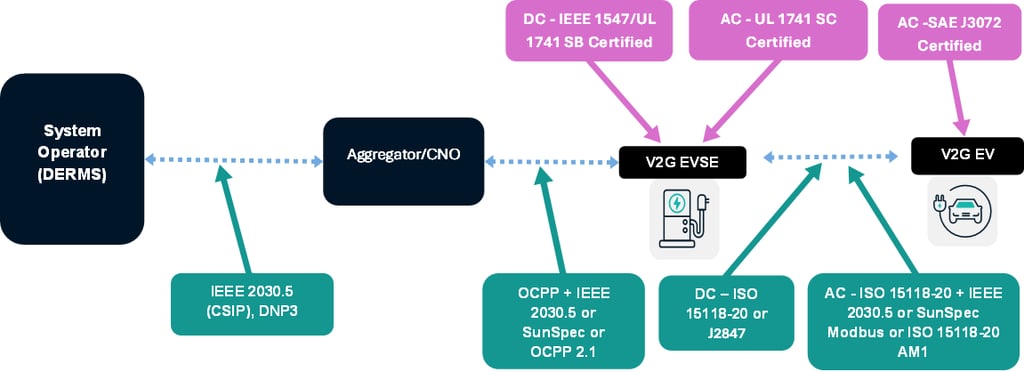
Proposed Testbed Configuration
Note: Diagram above depicts V2G AC End-to-End Testbed. The V2G DC system topology is the same, with the exception that the specific requirements for messaging and behaviors between the EV and EVSE apply the relevant protocols. While these standards represent approved protocols for VGI, other standards will be considered as requested.
In this Testbed, the default topology includes EVSE and EV simulators to represent both conformance to communications protocols and electrical functionality. The Testbed is preferentially configurable to enable substitution of actual Chargers and EV products, as shown above.
The partnership's objective is to simplify the base case analyses by treating HIL/SIL devices/systems as assumed to operate according to relevant requirements already defined by available standards - e.g., UL 1741 SC and SAE 3072. We acknowledge that this places a great deal of trust in the participants. We are hopeful that technically mature systems will be made available to identify gaps or opportunities to meet interoperability requirements. While the emphasis of this activity is to support demonstrations of the End-to-End communications for V2G, the Testbed will not to enable evaluation/validation of individual products; that effort is part of each participant's commercial development.
The Testbed generally facilitates evaluation of individual HIL/SIL devices/systems for a specific purpose. However, because the demonstration procedures include options for substituting any of the devices/systems under test to be represented by an emulated or simulated system, any of various scenario permutations can easily be addressed. To be clear, actual devices/systems can be utilized in place of the simulated systems, thereby enabling configuration versatility in the Testbed, achieving evaluation of functionality with actual products.
* Future iterations of the Testbed may be expanded to include a broader range of applications such as V1G, V2H, V2B, V2V, etc, but for October 2026 the scope is focused on V2G.
Participating in the Partnership
Testbed Objective
Monday-Friday of the week preceding the V2G Forum will support final integrated E2E Testbed development for both AC and DC Testbed Teams.


Mon., Oct. 19
Equipment move-in and setup.
Tue. - Fri. Oct. 20 - 23
Daily 9am - 5pm
AC and DC Team System Integration and Pre-Testing
- Evaluation of DTE and Proxy Server DERMS IEEE 2030.5/CSIP dispatch of automated functions and message flow sequencing
- Trials of encryption/decryption gates for Cybersecurity applying SAE EV PKI Certified Trust List along with IEEE 1547.3 & ISO 62443
- Final assessment of ISO 15118-20 for DC integration
- Preliminary ISO 15118-20 Amendment 1 and trials for AC
- IEEE 2030.5/CSIP comms evaluations
- SunSpec SAE J3072 IEEE 2030.5 Profile assessments
- UL 1741 SB/ SB CRD and UL 1741SC assessments
- SAE J3072 comms integration
-IEC 61850-7-420 Object Model assessments.
Evaluations will support PNNL Energy Services and ANL ChargeX and Test Plan architypes to support advanced development of UL and SAE Conformance Test Protocols. These leverage the SAE 2953/3 and ISO 15118-21/22/23 implementations.
Monday-Thursday of the week V2G Forum will support progression of integrated E2E Testbed evaluations to establish bases for Formal Conformance Test Development.
Mon., Oct. 26
9am - 12pm
Final system integration with go-live updates for Testbed
1pm - 5pm
Shakedown of back-to-back Use Case evaluations of integrated Testbed for both AC & DC Systems involving DTE DERMS and Emulated DERMS systems.
Tue., Oct. 27
9am - 12pm & 1pm - 5pm
- Go Live of Use Case Evaluations – Flow Reservation and Peak Shaving.
- Applying CSIP and Amd 1 implementations for Grid Energy Services.
- System introduction for visiting tours by V2G Forum attendees
Wed., Oct. 28
9am - 12pm
- Cybersecurity and SunSpec SAE J3072 IEEE 2030.5 and ISO 15118-20
- Amd 1 profile evaluations and gap closing.
1pm - 5pm
OCPP & OCPI eMSP/CNO/Aggregator optimization assessments.
Thu., Oct. 29
9am - 12pm
Testbed Debrief workshop
- Lessons learned
- SAE and UL Conformance Test Committee Lead Assignments and Task Force formation.
1pm - 3pm
Testbed breakdown and move-out
Testbed Schedule
Get in touch
Use this form to reach out. We will get back to you asap
Copyright 2026 Smart Grid Observer. All rights reserved